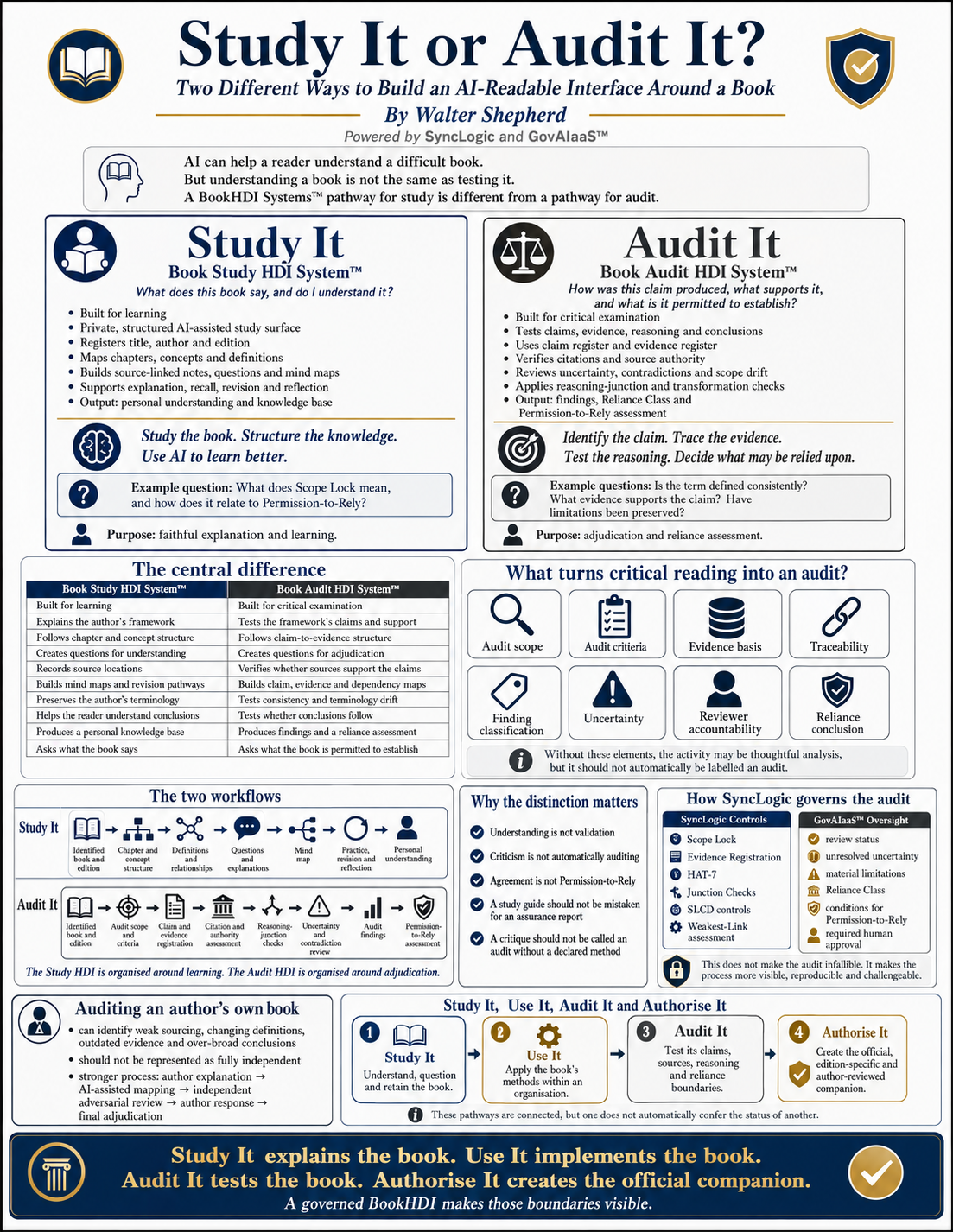
Artificial intelligence can help a reader understand a difficult book. It can explain concepts, compare chapters, generate questions and organise notes.
But understanding a book is not the same as testing it. A reader may finish a structured study process knowing exactly what the author argues, while still not knowing whether the book’s evidence supports those arguments, whether its citations are reliable, whether uncertainty has been preserved or whether its conclusions extend beyond what the evidence permits.
That distinction creates two separate BookHDI Systems™ pathways:
Study It asks: “What does this book say, and do I understand it?”
Audit It asks: “How was this claim produced, what supports it, and what is it permitted to establish?”
Both begin with an identified book and edition. Their purposes, controls and outputs are different.
What is a Book Study HDI System™?
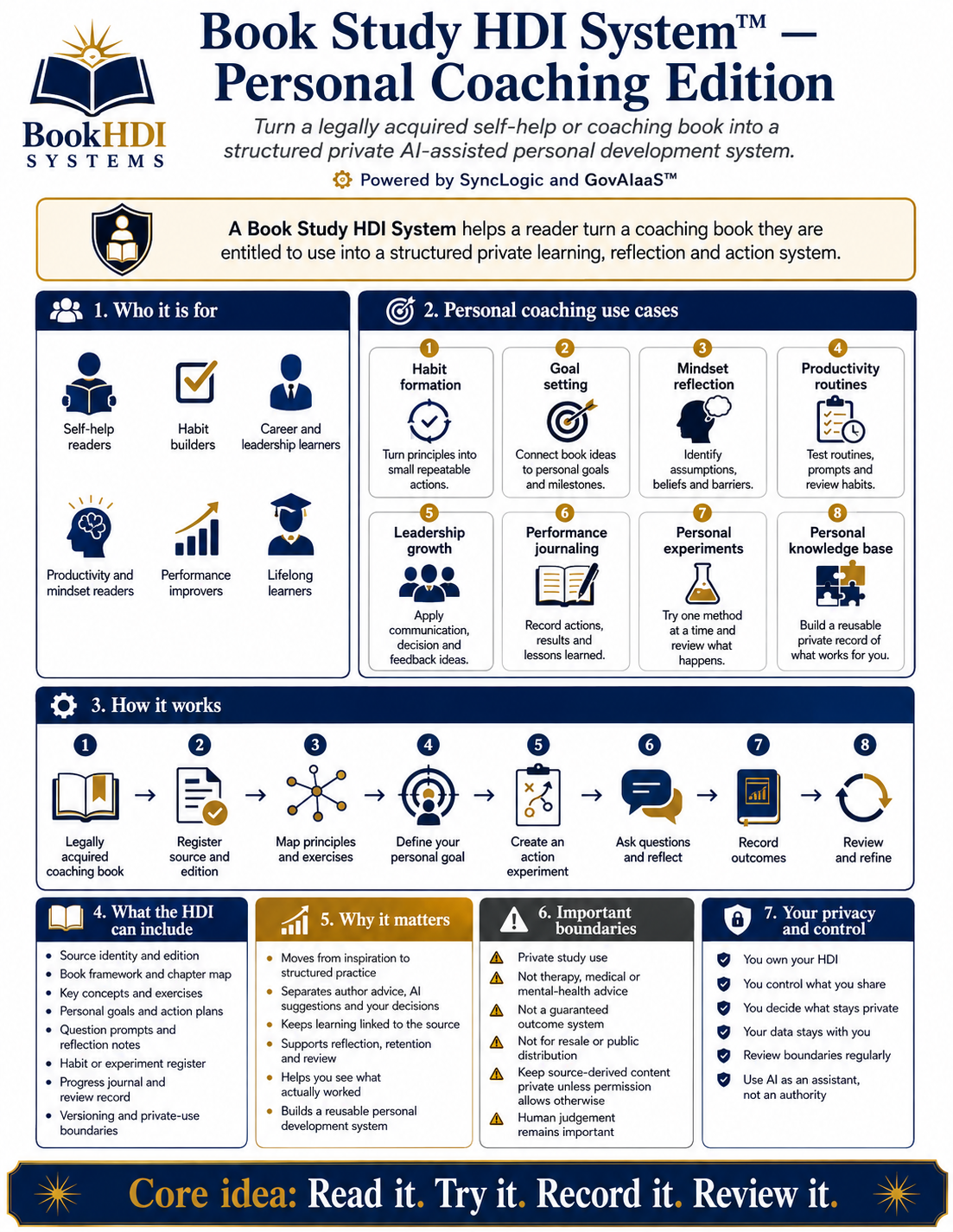
A Book Study HDI System™ turns a book into a private, structured AI-assisted learning surface. Its purpose is to help a student, professional or independent reader understand the source more deeply.
The Study HDI may register:
- the title, author and edition;
- chapter and section structure;
- concepts and definitions;
- relationships between ideas;
- source-linked notes;
- questions and difficult areas;
- mind maps, revision prompts and personal reflections.
The AI companion can then help the reader explain concepts, explore connections, practise recall and identify what remains unclear.
Study the book. Structure the knowledge. Use AI to learn better.
A Study HDI is organised around learning. Its purpose is faithful explanation and understanding.
What is a Book Audit HDI System™?
A Book Audit HDI System™ uses a more demanding process to examine the book’s claims, evidence, reasoning and conclusions. It does not begin by assuming the book is correct or incorrect. It asks whether particular claims can be traced to evidence that supports them and whether the authority attached to each conclusion is proportionate to the underlying material.
An Audit HDI may include:
- a claim register and evidence register;
- citation verification;
- an assumption register;
- claim-to-source mapping;
- source-authority assessment;
- contradiction and uncertainty records;
- reasoning-junction checks;
- scope-drift findings;
- source-independence review;
- transformation audit;
- Reliance Class and Permission-to-Rely assessment.
Identify the claim. Trace the evidence. Test the reasoning. Decide what may be relied upon.
The Audit HDI is organised around adjudication. It does not merely repeat the author’s reasoning; it tests the transformation from source to conclusion.
The central difference
| Book Study HDI System™ | Book Audit HDI System™ |
|---|---|
| Built for learning | Built for critical examination |
| Explains the author’s framework | Tests the framework’s claims and support |
| Follows the chapter and concept structure | Follows the claim-to-evidence structure |
| Creates questions for understanding | Creates questions for adjudication |
| Records source locations | Verifies whether sources support the claims |
| Builds mind maps and revision pathways | Builds claim, evidence and dependency maps |
| Preserves the author’s terminology | Tests consistency and changes in terminology |
| Helps the reader understand conclusions | Tests whether conclusions follow |
| Produces a personal knowledge base | Produces findings and a reliance assessment |
| Asks what the book says | Asks what the book is permitted to establish |
The distinction is not that Study It accepts everything while Audit It attacks everything. Good study can be critical. But criticism alone is not an audit.
What turns critical reading into an audit?
An audit needs more than hard questions. It needs a declared and repeatable method. At minimum, the process should identify:
- Audit scope — which edition, chapters, claims and evidence are being examined;
- Audit criteria — what standards or rules will be used;
- Evidence basis — which sources are admissible and how their authority and independence are assessed;
- Traceability — whether each finding can be traced to a specific claim, passage, citation or reasoning junction;
- Finding classification — supported, partly supported, unsupported, contradicted, unclear or outside scope;
- Uncertainty — what remains unknown, disputed or dependent on judgement;
- Reviewer accountability — who performed the review and under what limitations;
- Reliance conclusion — what the audited claim may reasonably be used for.
Without these elements, the activity may be thoughtful analysis, but it should not automatically be labelled an audit.
The two workflows
The Study HDI is organised around learning. The Audit HDI is organised around adjudication.
Why the distinction matters
Without a clear boundary, an AI-generated study guide can begin to look like an assurance report. A chatbot may explain a book fluently and then declare its argument “well supported” without registering claims, examining evidence or testing citations.
That is a form of certainty laundering: the fluency of the explanation is mistaken for the strength of the underlying evidence.
The reverse mistake is also possible. An aggressive critique may be called an audit even though it applies no stable criteria, records no evidence and gives the author no fair representation.
Understanding is not validation. Criticism is not automatically auditing. Agreement is not Permission-to-Rely.
How SyncLogic governs the audit
SyncLogic can provide the reasoning and transformation controls for a Book Audit HDI. These can include Scope Lock, Evidence Registration, HAT-7, Junction Checks, SLCD controls and Weakest-Link assessment. GovAIaaS™ can then provide the assurance layer through review status, unresolved uncertainty, material limitations, Reliance Class, conditions for Permission-to-Rely and required human approval.
This does not make the audit infallible. It makes the process more visible, reproducible and challengeable.
Auditing an author’s own book
An author may also use a Book Audit HDI to examine their own work. This can identify weak sourcing, changing definitions, outdated evidence, over-broad conclusions, lost uncertainty, citation errors and sections that should be marked as proposal rather than proof.
An author audit should not be represented as fully independent. A stronger process could separate author explanation, AI-assisted mapping, independent adversarial review, author response, and final adjudication and reliance status.
Study It, Use It, Audit It and Authorise It
The expanded BookHDI Systems model can be expressed as four distinct pathways:
- Study It — Book Study HDI System™ — understand, question and retain the book.
- Use It — Book Use HDI System™ — apply the book’s methods within an organisation.
- Audit It — Book Audit HDI System™ — test its claims, sources, reasoning and reliance boundaries.
- Authorise It — Author-Authorised AI Companion HDI™ — create an official, edition-specific and author-reviewed companion.
These pathways are connected, but one does not automatically confer the status of another.
Conclusion
Books need different AI interfaces for different purposes. A student seeking understanding should not be forced into a full audit process. An organisation preparing to rely on a method should not mistake a study summary for assurance. An auditor should not present personal disagreement as a formal finding. An authorised companion should not be confused with independent validation.
Study It explains the book. Use It implements the book. Audit It tests the book. Authorise It creates the official companion.
A governed BookHDI makes those boundaries visible. That is what allows AI to assist with books without allowing explanation, implementation, audit and authorisation to collapse into one uncontrolled answer.