Many books are written to coach the reader. They offer methods for building habits, improving productivity, setting goals, developing leadership skills, managing relationships or performing more consistently.
Readers often finish these books feeling inspired, highlight several passages and promise themselves they will act on the ideas.
Then everyday life resumes.
The book goes back on the shelf, the highlighted ideas fade, and the reader is left with enthusiasm but no structured way to test what was actually useful.
Read it. Try it. Record it. Review it.
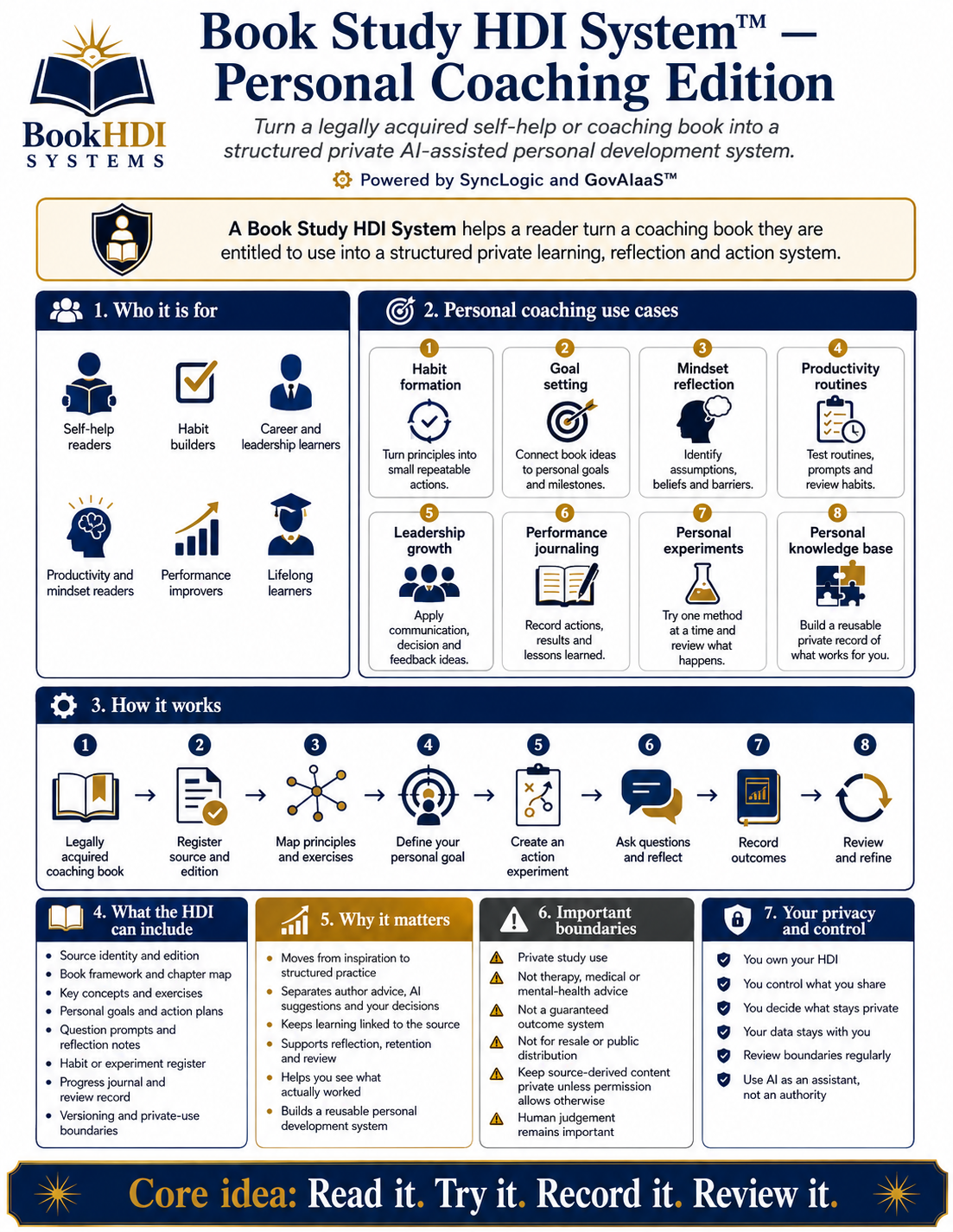
The Book Study HDI System™ — Personal Coaching Edition is designed to help close that gap. It turns a lawfully acquired self-help or coaching book into a private AI-assisted learning, reflection and action system.
From passive reading to structured personal learning
A Personal Coaching Edition does not treat a coaching book as a pile of inspiring quotes. It treats it as a source that can be identified, structured and worked through carefully.
Instead of asking a general AI, “Use this book to coach me,” the reader builds a private study interface around the actual book and edition they are using.
This turns broad advice into a more disciplined personal process.
What it can be used for
The Personal Coaching Edition is especially suited to books that help the reader improve behaviour, judgement or performance.
- Habit formation — turn a principle into a small repeatable action.
- Goal setting — connect book ideas to personal goals and milestones.
- Mindset reflection — identify assumptions, beliefs and barriers.
- Productivity routines — test routines, prompts and review habits.
- Leadership growth — apply communication, decision and feedback ideas.
- Performance journaling — record actions, results and lessons learned.
- Personal experiments — try one method at a time and review what happens.
- Personal knowledge base — build a reusable private record of what works for you.
Examples of applicable book types
This model could be useful for a wide range of self-help, coaching and development books. Popular examples include titles such as:
- Atomic Habits — James Clear
- The 7 Habits of Highly Effective People — Stephen R. Covey
- Deep Work — Cal Newport
- Essentialism — Greg McKeown
- Mindset — Carol S. Dweck
- Grit — Angela Duckworth
- How to Win Friends and Influence People — Dale Carnegie
- Radical Candor — Kim Scott
- Dare to Lead — Brené Brown
- Peak — Anders Ericsson and Robert Pool
These titles are examples only. Their inclusion does not imply endorsement, partnership or authorisation by the authors or publishers.
With and without a Personal Coaching HDI
| Ordinary reading or generic AI use | Book Study HDI — Personal Coaching Edition |
|---|---|
| Highlight inspiring passages and hope they stick | Register the source, concepts and intended use |
| Try several ideas at once | Select one defined personal experiment |
| Rely on memory and motivation | Record actions, observations and review dates |
| Ask AI for generic life advice | Ask source-linked questions within the book’s framework |
| Mix the author’s advice with AI suggestions | Separate source content, AI input and personal decisions |
| Assume an idea worked because it felt good | Review what actually happened and what remains uncertain |
| Move on after initial enthusiasm | Build a reusable personal learning record |
What the HDI can include
- source identity and edition;
- book framework and chapter map;
- key concepts and exercises;
- personal goals and action plans;
- question prompts and reflection notes;
- a habit or experiment register;
- a progress journal and review record;
- versioning and private-use boundaries.
Important boundaries
This edition is for private study use. It is not therapy, medical advice, mental-health treatment or a guaranteed outcome system. It is not for resale or public distribution, and source-derived content should remain private unless permission allows otherwise.
No official Personal Coaching Edition will be released for a third-party book unless the necessary author, publisher or rights-holder permission has been obtained.
The AI should assist the reader, not replace the source or silently rewrite the author’s method.
Why it matters
The Personal Coaching Edition helps move from inspiration to structured practice. It helps the reader separate the author’s advice, AI suggestions and their own decisions. It keeps learning linked back to the source. It supports reflection, retention and review. Most importantly, it helps the reader see what actually worked for them.
The book provides the framework. The AI assists the process. The reader makes the decisions. The record shows what happened.
A more disciplined way to use self-help books
Many coaching books contain useful ideas. The problem is rarely a shortage of advice. The problem is the lack of a structured way to turn advice into personal learning and action.
That is what the Book Study HDI System™ — Personal Coaching Edition is intended to do. It helps a reader create a private knowledge surface around a book, define a goal, test one method at a time, record what happened and review the result.
In short:
Read it. Try it. Record it. Review it.