Artificial intelligence can summarise a book, explain a scientific paper or extract the recommendations from a report.
But summarising a document does not reveal how its argument was constructed.
A reader may understand the conclusion without seeing how the author led the reader towards it, which definitions shaped the discussion, how evidence and examples were combined, whether competing views were represented fairly, or where the argument became unclear, repetitive or overstated.
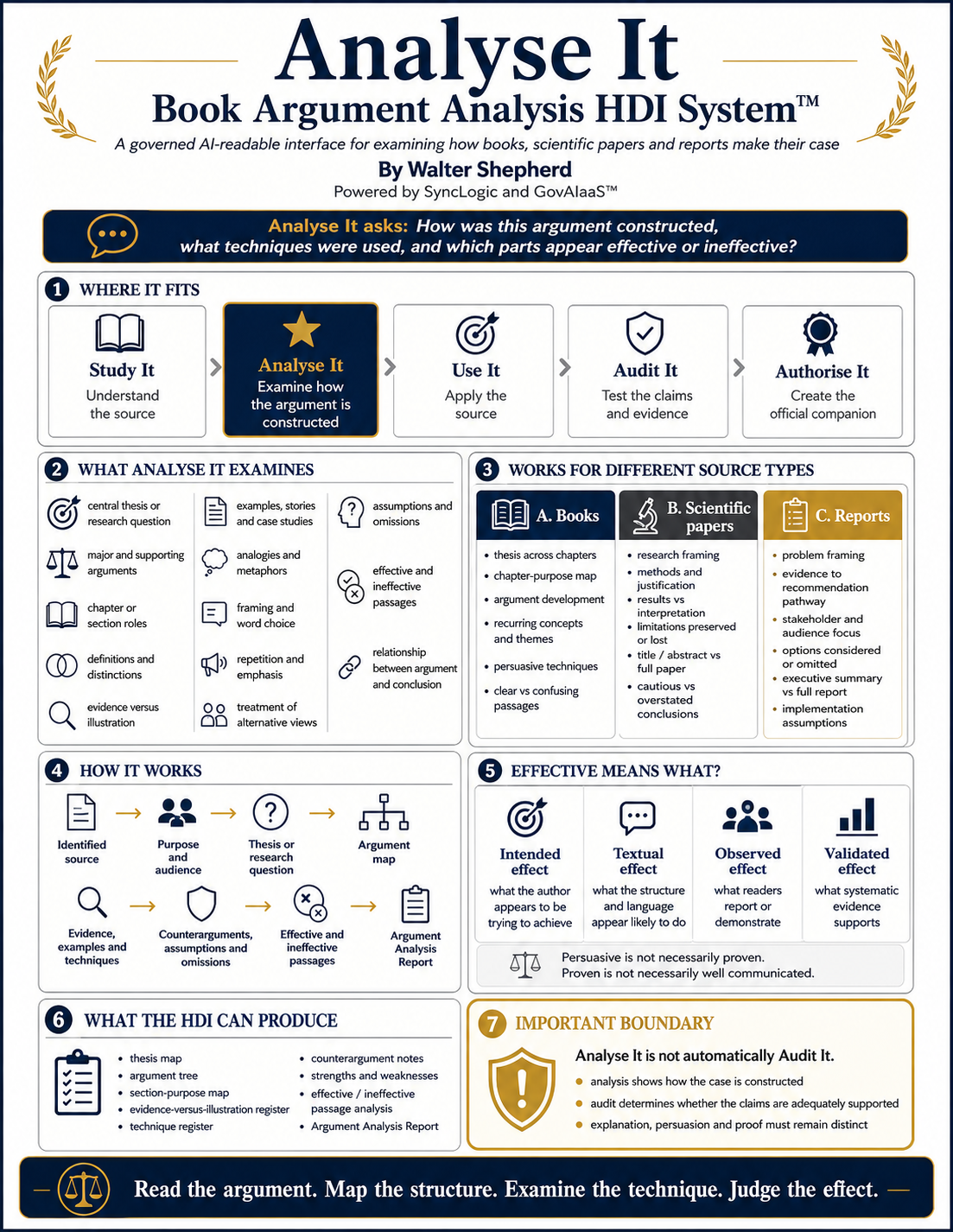
The proposed Book Argument Analysis HDI System™ — Analyse It creates a structured AI-readable interface for examining how a document makes its case.
How was this argument constructed, what techniques were used, and which parts appear effective or ineffective?
Although Analyse It begins within BookHDI Systems™, the same method can be adapted to books, scientific papers, technical reports, policy documents and organisational reviews.
Analyse It is different from Study It and Audit It
BookHDI Systems separates several purposes that can otherwise become blurred.
| Pathway | Main question |
|---|---|
| Study It | What does this source say, and do I understand it? |
| Analyse It | How does this source construct and communicate its argument? |
| Use It | How can its methods be applied in practice? |
| Audit It | Are its claims adequately supported, and what may be relied upon? |
| Authorise It | How can an official, source-approved AI companion be created? |
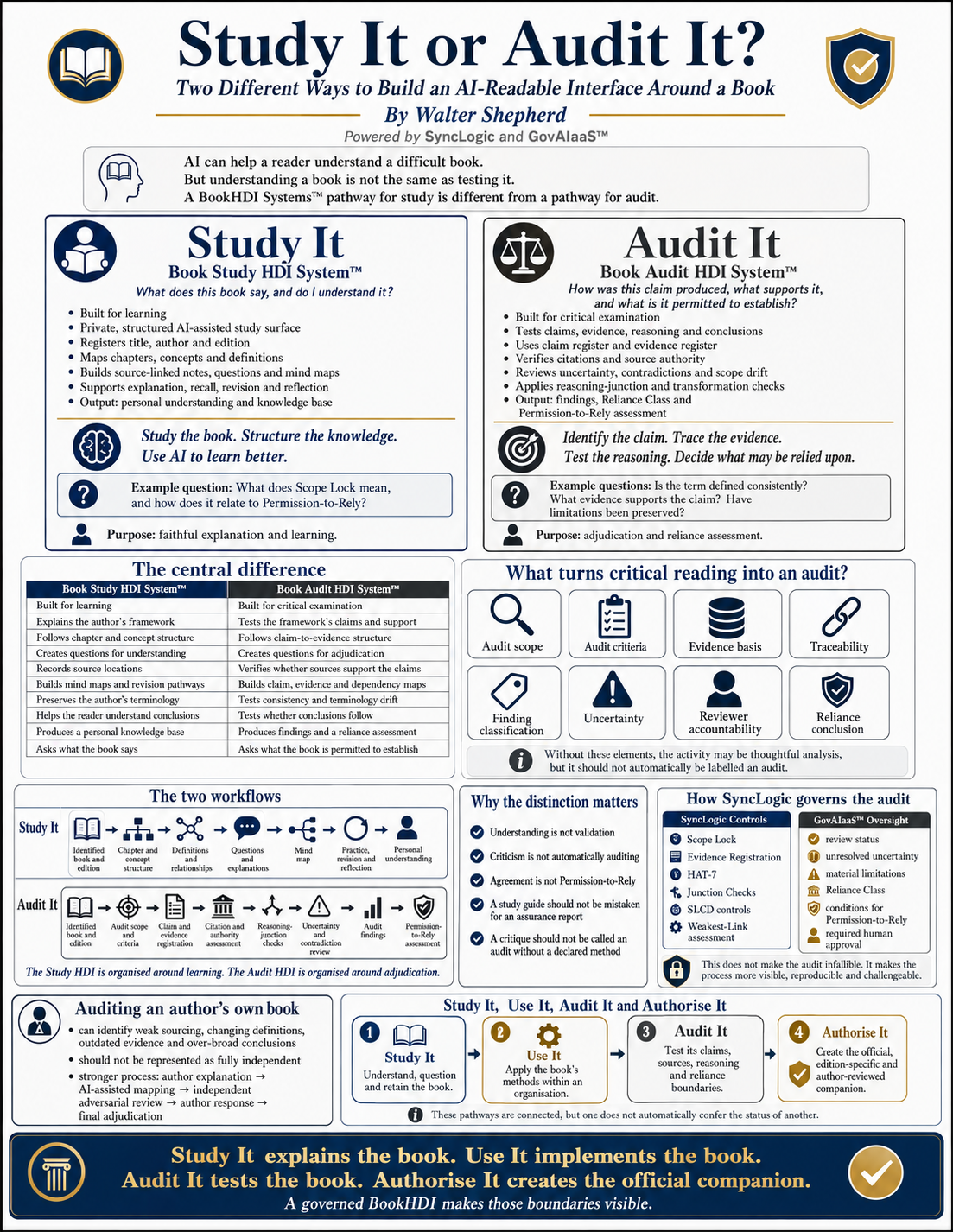
A Study HDI explains the argument. An Analyse HDI examines how the argument works. An Audit HDI tests whether the argument’s claims are sufficiently supported.
Understanding is not analysis. Analysis is not automatically audit. Persuasion is not proof.
What Analyse It examines
The Book Argument Analysis HDI System can identify and map:
- the central thesis or research question;
- major and supporting arguments;
- chapter or section roles;
- definitions and distinctions;
- assumptions and omissions;
- evidence and illustrations;
- stories, examples and case studies;
- analogies and metaphors;
- framing, word choice, repetition and emphasis;
- appeals to authority and treatment of alternative views;
- changes in tone or certainty;
- effective and ineffective passages;
- the relationship between the argument and the conclusion.
The purpose is not to decide immediately whether the author is right or wrong. It is first to make the argument visible.
A simple Analyse It workflow
The completed HDI becomes a reusable analytical knowledge surface rather than a one-time AI summary.
Analyse It for books
Books often build arguments across many chapters. The author may introduce terminology early, develop examples gradually, postpone objections or repeat phrases to establish a central idea. A general AI summary may flatten this structure into a few paragraphs.
An Analyse It HDI can instead ask:
- What is the book’s central purpose?
- What role does each chapter play?
- Where is the thesis stated or developed?
- How does the author move from one claim to the next?
- Which examples clarify the method, and which are merely illustrative?
- Are alternative views considered fairly?
- Does the conclusion follow the structure established earlier?
- Which passages are especially clear, persuasive or memorable?
- Which sections are repetitive, unsupported or confusing?
For Rethinking AI Reasoning, a Study HDI might explain Scope Lock. An Analyse HDI would examine why the concept is introduced at that point, which contrasts and examples are used, whether the terminology remains consistent and which passages could be made clearer. An Audit HDI would then ask what evidence supports the claimed benefits and what the method is permitted to establish.
Analyse It for scientific papers
Scientific papers also construct arguments. They make choices about how the research problem is framed, which literature is treated as authoritative, how methods are justified, how results are presented and how cautiously the conclusion is worded.
Analyse It can ask whether the discussion stays close to the results, whether associations are described as causation, whether negative findings receive fair attention, whether the abstract represents the full paper and whether uncertainty survives into the title and conclusion.
This can show how a scientific claim acquires authority as it moves from data to interpretation. It is not automatically peer review or evidence audit; those require declared criteria, source verification, methodological assessment and documented findings.
Analyse It for reports
Government, corporate, consultancy and policy reports often describe a problem, interpret evidence, frame stakeholder interests, compare options and recommend action. Recommendations may appear to follow directly from evidence even when they also depend on values, priorities or policy choices.
An Analyse It HDI can examine who commissioned the report, its intended audience, how the problem was framed, which evidence received authority, which stakeholders and alternatives were included or omitted, whether recommendations arise from evidence or preference, and whether the executive summary represents the detailed report fairly.
Evidence is not the same as illustration
One of the most useful Analyse It controls is separating evidence from other persuasive material.
| Material | Possible role |
|---|---|
| Data | Empirical support |
| Citation | External authority or evidence |
| Example | Illustration |
| Story | Engagement or emotional connection |
| Analogy | Explanation or conceptual transfer |
| Case study | Demonstration in a particular setting |
| Expert quotation | Authority or interpretation |
| Repetition | Emphasis and memorability |
A memorable story may be persuasive while contributing little proof. An analogy may clarify a concept but fail if treated as direct evidence. A case study may demonstrate possibility without demonstrating general effectiveness.
What does “effective” mean?
Analyse It must use the word effective carefully. From the document alone, an analyst may assess whether a passage appears clear, coherent, memorable or well structured. But the text alone usually cannot prove how actual readers responded.
- Intended effect — what the author appears to be trying to achieve.
- Textual effect — what the structure and language appear likely to do.
- Observed effect — what actual readers report or demonstrate.
- Validated effect — what systematic evidence supports.
Without reader testing or other evidence, Analyse It should not declare that a technique definitively persuaded or educated the audience. It should state that the technique appears designed or likely to produce a particular effect.
What the Argument Analysis HDI can produce
A completed Analyse It HDI may contain:
- a source identity and purpose record;
- a thesis or research-question map;
- a chapter or section-purpose map;
- an argument tree;
- definitions and distinctions;
- an evidence-versus-illustration register;
- a technique, example and analogy register;
- counterargument, assumption and omission notes;
- effective and ineffective passage analysis;
- uncertainty and review records;
- a final Argument Analysis Report.
Scientific-paper versions could add method-to-result, result-to-conclusion and abstract-to-full-paper comparisons. Report versions could add evidence-to-recommendation maps, stakeholder framing, option comparison and executive-summary review.
Why Analyse It matters
Analyse It helps readers move beyond two common reactions: “I agree with this book” or “I disagree with this report.” Agreement and disagreement do not reveal how the argument was constructed.
A structured analysis can show why a passage is compelling, why another is confusing, where definitions change, where evidence becomes illustration, where a counterargument is represented fairly, and where a conclusion gains more certainty than the preceding discussion permits.
This supports better reading, writing, teaching, editing, research communication, policy evaluation and organisational decision-making.
Analyse It is not automatically Audit It
An argument analysis can identify a possible weakness without establishing an audit finding. For example, “The conclusion appears broader than the examples presented” is an analytical observation.
To turn that into an audit finding, the process would need to define the claim, criteria, complete evidence base, source locations, reviewer, uncertainty, classification and reliance consequence.
Analyse It identifies how the case is constructed. Audit It determines whether the case is adequately supported.
How SyncLogic and GovAIaaS™ apply
SyncLogic can govern the transformation from document to argument map by requiring source registration, Scope Lock, separation of source and AI interpretation, traceability to passages or data, explicit assumptions, control of scope inflation, preservation of uncertainty and review of reasoning junctions.
GovAIaaS™ can record human-review status, limitations, unresolved disagreements, intended use, applicable Reliance Class, whether the output is analysis, audit or commentary, and the conditions attached to Permission-to-Rely.
This does not make the analysis automatically correct. It makes the analytical process more visible, reproducible and open to challenge.
Where Analyse It fits
Study It explains what the source says. Analyse It examines how the source makes its case. Use It applies the source. Audit It tests what the source is permitted to establish. Authorise It creates the official companion.
Conclusion
Books, scientific papers and reports are not merely containers of information. They are structured attempts to explain, interpret, persuade, demonstrate or recommend.
AI can help make those structures visible—but only if the process separates explanation from analysis, persuasion from proof and analysis from audit.
The Book Argument Analysis HDI System™ provides a governed pathway for examining what the argument is, how it develops, what techniques it uses, where it appears effective, where it appears weak, and what would require further evidence before a stronger conclusion could be made.
Read the argument. Map the structure. Examine the technique. Judge the effect.