Readers are already using artificial intelligence to explain books, answer questions, generate summaries, compare ideas and apply methods in study or business.
That development is unlikely to stop.
What controls should govern the transformation from the book to the AI-generated answer?
In ordinary AI use, a reader types the name of a book into a chatbot and asks a question. The response may be useful, but the reader may not know which edition the AI is discussing, whether the model has reliable access to the source, whether it is relying on reviews or second-hand commentary, or whether it has invented an interpretation that the author never made.
The answer may sound authoritative while its relationship to the book remains unclear.
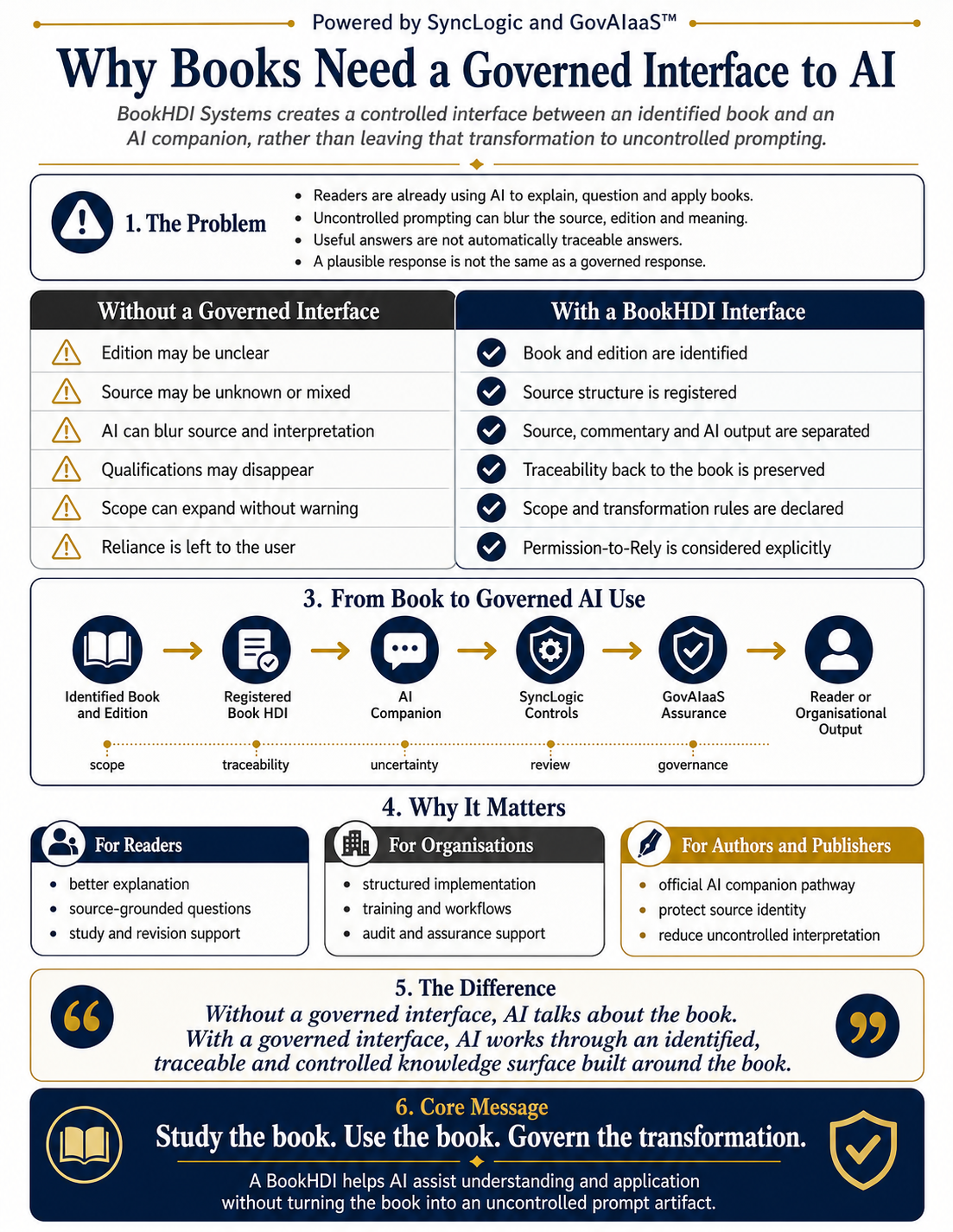
BookHDI Systems™ proposes a different model: a governed interface between an identified book and an AI companion. The purpose is not to replace the book. It is to make the AI-assisted use of the book more structured, traceable and accountable.
The uncontrolled-prompting model
Without a governed interface, the process is usually:
The apparent simplicity conceals several uncertainties.
The AI may not know which edition the reader means. It may combine material from the book with interviews, reviews, online discussions and unrelated sources. It may compress a qualified argument into an oversimplified conclusion. It may attribute an AI-generated interpretation to the author or provide a quotation that does not exist.
The reader often receives only the final answer. They may not be able to determine:
- which source supported it;
- where the supporting material appears in the book;
- whether the author actually said it;
- whether uncertainty was preserved;
- whether the answer exceeded the book’s scope;
- whether the response came from the book at all.
This does not mean every ordinary AI answer is wrong. It means the conditions under which the answer was produced are often unclear.
A plausible response is not automatically a traceable response.
A governed book-to-AI interface
A BookHDI begins with an identified source.
That source is registered by title, author, edition and relevant version. Its scope, structure, terminology and exclusions are recorded before the AI companion is asked to interpret or apply it.
The interface does not merely supply content to an AI model. It also defines how that content may be used.
It can specify:
- the edition being discussed;
- the approved scope;
- key concepts and definitions;
- relationships between chapters and ideas;
- source locations;
- author commentary;
- questions and learning pathways;
- permitted and prohibited transformations;
- human-review status;
- version and update history;
- licensing and access conditions.
The result is not a guarantee that the AI can never make an error. It is a controlled environment in which errors, uncertainty and transformation boundaries are easier to identify.
With and without a governed interface
| Without a governed interface | With a BookHDI interface |
|---|---|
| The edition may be unclear | The title and edition are registered |
| The AI may rely on unknown material | Approved sources are identified |
| The response may mix source and commentary | Source, author commentary and AI interpretation are separated |
| Claims may not link back to the book | Source-location traceability is built in |
| The prompt defines the scope informally | Scope is declared and locked |
| Qualifications may disappear during summarisation | Uncertainty and limitations are preserved |
| AI interpretations may appear to be the author’s views | Provenance labels show who created or approved each element |
| Outputs may vary without explanation | Instructions, versions and review records support reproducibility |
| The reader receives an answer | The reader receives an answer within a governed knowledge system |
| Reliance is assumed by the user | Permission-to-Rely is considered explicitly |
The central difference is not simply better prompting. It is the movement from an informal conversation to a governed transformation process.
Protecting the identity of the source
A book is more than a collection of sentences. Its meaning may depend on:
- the order of its argument;
- definitions introduced earlier;
- distinctions between chapters;
- evidence and references;
- qualifications and exclusions;
- examples that limit or explain a claim;
- the author’s declared purpose.
Ordinary AI prompting can detach a statement from that structure.
A BookHDI preserves the identity of the source while making its structure readable by an AI system. It can help the companion distinguish between what the book states, what the author later adds, what the HDI developer organises and what the AI generates.
That distinction is essential.
Without it, an AI-generated explanation can gradually acquire the authority of the book even though the author never wrote or approved it. This is a form of Source Authority Transfer: authority moves from the original source to a transformation that may not deserve the same status.
A governed interface makes that transfer visible and contestable.
The difference for study
A student may ask a general AI:
“Explain Chapter 6 of this book.”
The AI may produce a convincing explanation, but the student may have no way to know whether it reflects Chapter 6, a review of the book, or the model’s general knowledge of the subject.
A Book Study HDI System™ can instead help the student:
- identify the exact edition;
- map the chapter’s concepts;
- record what remains unclear;
- ask source-grounded questions;
- create a mind map;
- generate practice and revision activities;
- check explanations against the source;
- preserve personal notes separately from the book.
The AI supports reading rather than displacing it.
Study the book. Structure the knowledge. Use AI to learn better.
The difference for organisational use
The risks increase when an organisation attempts to implement a method from a book.
A general AI might be asked:
“Create an AI governance policy based on Rethinking AI Reasoning.”
The resulting policy could sound professional while omitting controls, changing terminology, expanding the book’s claims or applying the method outside its intended scope.
A Book Use HDI System™ provides a more disciplined route.
The organisation can register the authorised source, identify relevant concepts, map them to its operating environment, develop policies and procedures, train staff, test implementation and retain review records.
For Rethinking AI Reasoning, this could include:
- Scope Lock;
- Evidence Registration;
- HAT-7;
- Junction Checks;
- SLCD failure detection;
- Reliance Classes;
- Permission-to-Rely;
- audit and assurance workflows.
The book moves from something employees merely read to a structured organisational knowledge and implementation resource.
Read the book. Structure the method. Apply it with governance and assurance.
The difference for authors and publishers
Readers are already asking AI about published books, whether the author participates or not.
This creates a strategic choice.
An author or publisher can leave the interpretation of the book to uncontrolled third-party prompting, or create an official, edition-specific AI companion with defined permissions and author review.
The author or publisher retains control of the original work. The HDI provides a licensed companion layer around it.
It should not become an unauthorised reconstruction or substitute edition. Instead, it should direct readers back to the book for the complete argument, evidence, examples and context.
The companion increases the usefulness of the book without claiming to replace it.
Why governance matters
AI can explain a book quickly.
Governance asks the questions speed alone does not answer:
- Which book and edition?
- What source supports this response?
- Has the meaning changed?
- Has the scope expanded?
- Were uncertainty and disagreement preserved?
- Is the output the author’s view, a developer’s structure or an AI-generated interpretation?
- What is the reader permitted to rely upon?
- Who remains accountable?
These questions do not make AI less useful. They make its usefulness more defensible.
From prompting to governed use
The future relationship between books and AI should not be reduced to unrestricted copying, generic summarisation or uncontrolled chat.
Books need an interface that protects source identity while enabling explanation, exploration, learning and implementation.
BookHDI Systems™ is being developed as that interface.
It creates a controlled pathway between an identified book and an AI companion, governed through SyncLogic and supported by GovAIaaS™ assurance.
The aim is not to declare every answer correct. It is to make the relationship between the source, the transformation and the resulting output visible enough to inspect, question and govern.
Without a governed interface, AI talks about the book.
With a governed interface, AI works through an identified, traceable and controlled knowledge surface built around the book.