Artificial intelligence can produce an answer in seconds. But speed, fluency and confidence do not establish that an answer is accurate, adequately sourced, within scope or safe to rely upon.
That raises a more important question: can a general-purpose AI model be temporarily configured to reason within a defined source, scope and system of controls—and can we verify that it consistently follows those controls?
Using Talkory.ai, substantially the same proposition was put to five leading AI models:
- Grok 4.3;
- Gemini 3.1 Pro;
- Perplexity Sonar Reasoning Pro;
- Claude Sonnet 4.6; and
- GPT-5.5.
This was a structured multi-model reasoning comparison, not a statistically representative scientific survey. It examined where the responses converged, diverged or overreached.
The question put to the models
The models were asked whether they could operate within a Governed Reasoning State created through the combination of:
The question was not whether an AI could acquire a new mind or permanently alter its neural architecture. It was whether the model’s behaviour during a particular session could be materially organised and constrained by registered knowledge, conceptual structure and governing instructions.
The common answer
An AI can operate within a temporary, session-specific governed configuration—but it does not become permanently governed.
The models generally agreed that the state could be established using a registered source, an authorised HDI, a Mind Map, a Session Instruction Protocol, an AI model and human reviewers retaining final authority.
They also recognised that the state could weaken when governing materials became unavailable, instructions were displaced, scope changed, context was truncated, unsupported material entered the reasoning chain or human review was removed.
Agreement among models is not proof. Several systems can reproduce the same assumption or respond similarly to the same framing. Cross-model consensus is evidence about model behaviour, not independent verification of the underlying claim.
What each model contributed
Claude Sonnet 4.6: technical limits
Claude gave the clearest explanation that session instructions do not erase pretraining. They can require provenance discipline and source separation, but unsupported material can still be generated and the HDI itself can be incomplete or inaccurate.
Sonar Reasoning Pro: governance must be measured
Sonar distinguished the complete Governed Reasoning Environment, the configuration active in the current session and the capability available while that state is maintained. It also argued that governance should be tested through scenario evaluation, logs, drift monitoring and escalation—not assumed from model acknowledgement.
GPT-5.5: an operational protocol
GPT-5.5 proposed an activation template, SIP, provenance labels, uncertainty labels, Reliance Classes, escalation triggers and a governed-output format. It also produced the study’s strongest concise formulation: a Governed Reasoning State is a control condition, not a truth guarantee.
Grok 4.3: executive clarity
Grok provided a clear activation sequence from source registration through HDI, Mind Map and SIP controls to configured assistance and human review. Its weakness was occasionally treating governance as active merely because the instructions had been supplied.
Gemini 3.1 Pro: revealing overreach
Gemini made useful observations about context limits, scope drift and weakest-link dependence, but overstated what session instructions could disable or override. Its response demonstrated how a persuasive explanation can exaggerate the authority of a source and the effectiveness of its controls.
Instruction is not enforcement
Taken together, the five responses amounted to a significant qualification:
“I can be told what I am required to do, but that does not guarantee I will consistently do it.”
An LLM is not consciously choosing to disobey. Compliance can fail because instructions fall out of context, competing instructions take priority, pretrained patterns influence the answer, missing information is filled, scope or provenance is misclassified, sources are incomplete or the model generates the wrong output.
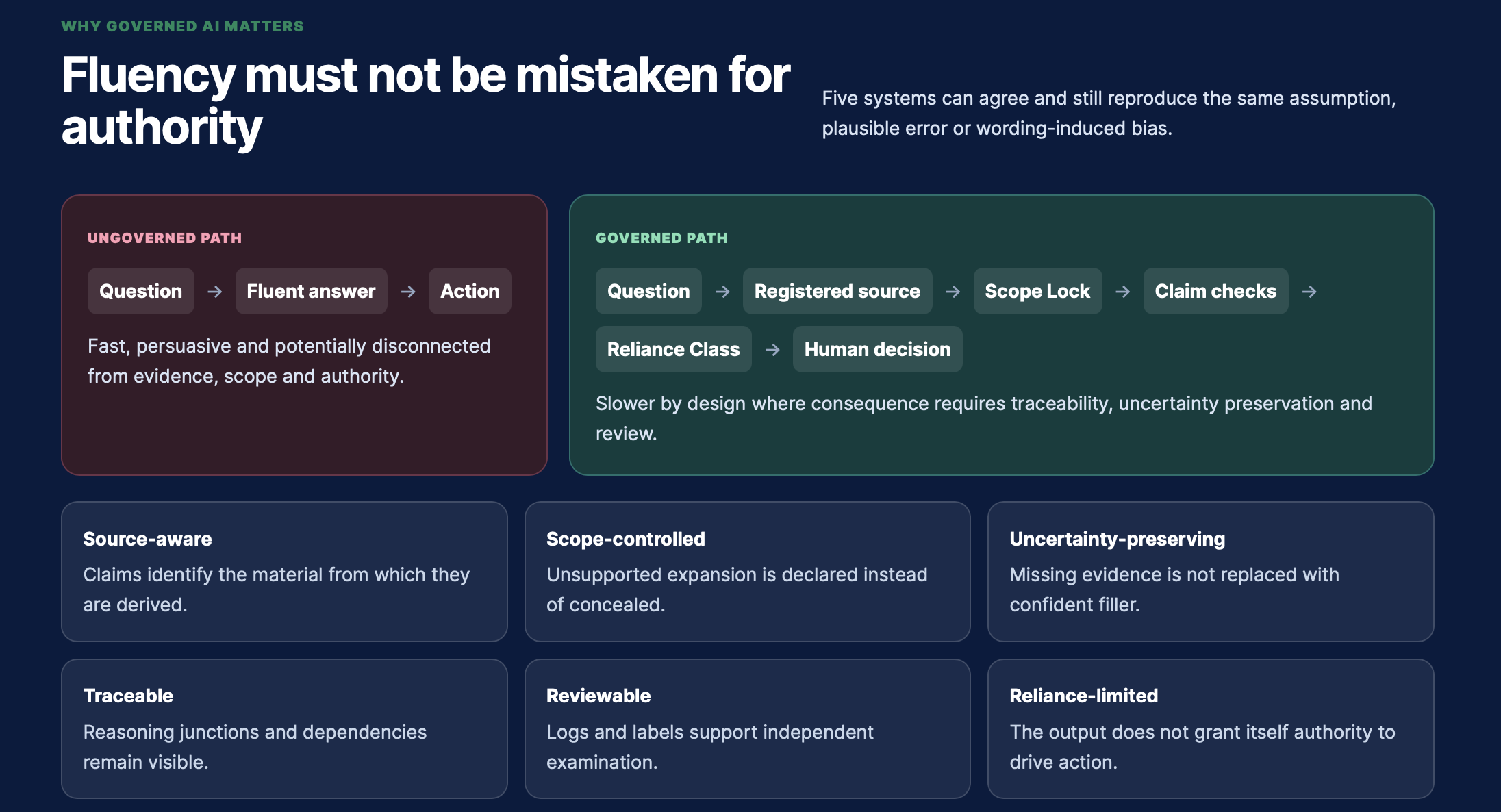
A prompt tells the AI what it should do.
Governance checks whether it actually did it.
A SIP can define required behaviour. It cannot independently prove that the behaviour occurred. The model may understand the rule, repeat it and claim to be following it while still producing an output that violates it.
Two governance layers are required
First: establish a Governed Reasoning State
The internal reasoning condition is created using:
- a registered source;
- an authorised HDI;
- a Mind Map;
- a versioned SIP;
- controlled model interaction; and
- defined human authority.
These components establish what the model should do.
Second: provide governed external enforcement
GovAIaaS must independently examine whether the required behaviour actually occurred. External assurance should check source use, scope compliance, provenance accuracy, unsupported claims, reasoning transformations, uncertainty, output restrictions, escalation and Permission-to-Rely requirements.
This layer determines what the model actually did.
Why this matters for BookHDI Systems
A BookHDI provides more than a summary. It creates an AI-readable interface around an identified source, including authorised definitions, concepts, relationships, workflows, limitations, source locations, review questions and reliance boundaries.
The registered source and authorised HDI define what knowledge is available. The Mind Map provides orientation. The SIP governs how the model should behave. Human review retains authority.
But the survey shows why these internal controls must be paired with independent assurance. A BookHDI can establish a stronger reasoning condition; GovAIaaS must still test whether the resulting output remained within source, scope and reliance boundaries.
Conclusion
The most important result was not that five models agreed. It was that their answers revealed both sides of the AI governance problem.
Modern AI can understand, describe and participate in sophisticated reasoning controls. It cannot be the sole authority certifying the accuracy of its source representation, the adequacy of its reasoning, the completeness of its provenance, the effectiveness of its controls or its own Permission-to-Rely.
The Governed Reasoning State tells the AI what it is required to do. Governed external enforcement verifies whether it actually did it.
A model’s declaration that it followed the rules is not sufficient evidence of compliance.
The final lesson is simple: instruction is not enforcement.